Published by The Next Gen Technologies | thenextgentechnologies.com
There is a moment every business dreads — the moment a customer walks through the door, sees a disorganized crowd of waiting people with no visible system, no indication of expected waiting time, and no confidence that their turn will ever come fairly — and turns around and walks back out. That moment costs revenue, damages reputation, and hands a competitor an opportunity that should never have been available. A modern Queue Management System prevents this moment from ever occurring — replacing the anxiety of unmanaged waiting with the reassurance of organized, transparent, and efficiently managed service delivery that keeps customers present, informed, and satisfied from arrival to service completion.
In today’s experience-driven economy, the quality of how a business manages customer waiting is not a peripheral operational detail — it is a core component of the service proposition that directly determines customer loyalty, brand perception, and long-term revenue performance.
Queue Management System: Engineering the Perfect Customer Waiting Experience
A Queue Management System is a comprehensive technology platform that transforms the chaotic, stressful, and wasteful experience of unmanaged customer queuing into a structured, transparent, data-driven, and continuously optimized service flow. From the moment a customer arrives at any service environment to the moment their service need is fully addressed, the system manages every dimension of their experience — ensuring efficiency, fairness, and satisfaction at every touchpoint.
The technological architecture of a genuinely advanced Queue Management System integrates multiple intelligent components into a cohesive customer experience platform:
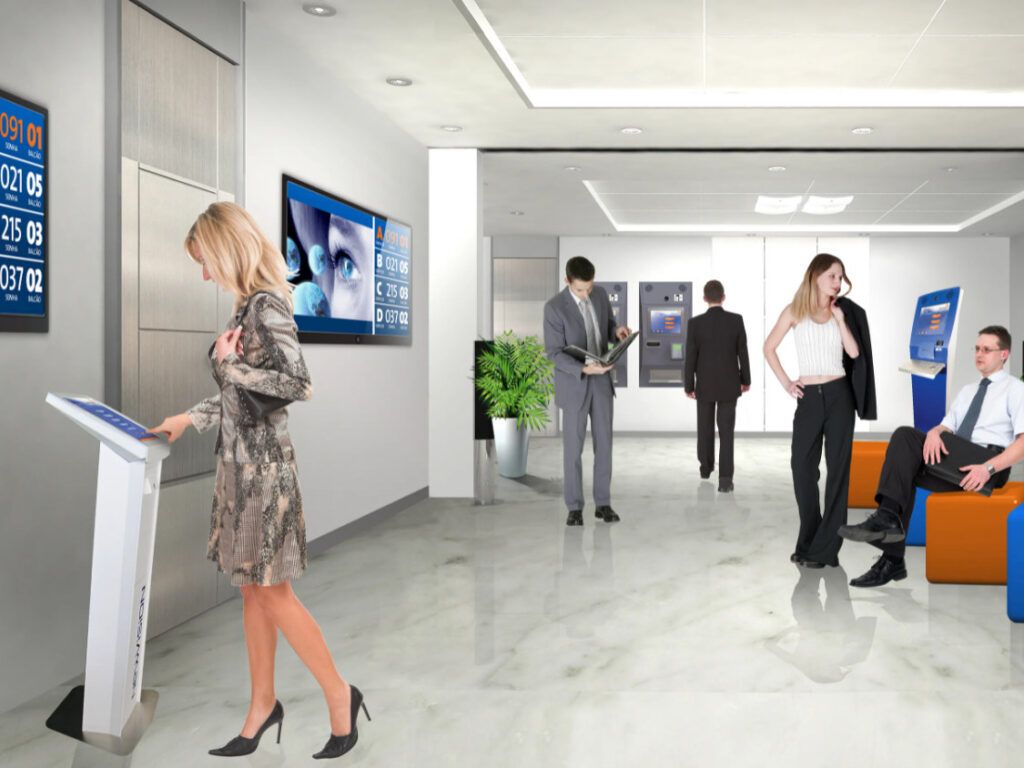
- Multi-channel queue entry — allowing customers to join service queues through physical kiosk token dispensers, mobile smartphone applications, QR code scanning, web browser access, or SMS registration — meeting customers through whichever channel best suits their preference and circumstances
- Intelligent service routing — automatically analyzing each customer’s service requirement and directing them to the most appropriately qualified and currently available service counter, minimizing misdirection and unnecessary repeat interactions
- Real-time waiting transparency — digital display screens positioned strategically throughout waiting areas showing current queue status, estimated waiting times, and counter call announcements in clear, multilingual formats
- Dynamic staff allocation tools — management dashboards showing real-time counter utilization, queue depth, and service velocity data that enable supervisors to deploy additional staff resources to address emerging bottlenecks before they generate customer dissatisfaction
- Virtual queuing capability — enabling customers to register for service remotely and receive notifications when their turn approaches, eliminating the need for physical waiting entirely for those who prefer this option
- Customer journey analytics — comprehensive data capture across every service interaction, generating insights on arrival patterns, service duration distributions, peak period identification, and satisfaction trends that drive continuous operational improvement
- Automated service quality measurement — integrated customer feedback mechanisms that capture satisfaction data at the point of service completion, providing management with real-time quality intelligence
- Multi-branch centralized management — unified administration and reporting across all locations of multi-site organizations, enabling enterprise-wide queue performance monitoring from a single platform
The cumulative effect of these integrated capabilities is a service environment where customers feel respected, informed, and confident — and where management has the data, tools, and visibility to continuously improve service performance in ways that manual observation and intuition alone could never achieve.
Queue Management System in Riyadh: Elevating Service Excellence in the Kingdom’s Most Demanding Market
Riyadh is the most complex service delivery environment in Saudi Arabia — a city of extraordinary scale, intensity, and diversity where millions of residents interact daily with government services, healthcare providers, financial institutions, telecom operators, retail businesses, and countless other service organizations whose customer volumes and service complexity place them among the most demanding queue management challenges anywhere in the world. The demand for intelligent, scalable, and reliable Queue Management Systems in Riyadh has never been more urgent or more strategically important.
The capital’s unique service environment characteristics create specific queue management imperatives:
- Government service transformation priority — Riyadh’s major government service centers process thousands of citizen interactions daily across multiple service categories with different complexity levels, priority classifications, and processing times — requiring queue management systems capable of handling multi-dimensional routing logic at high volumes without degradation in performance or fairness
- Healthcare sector patient flow complexity — the capital’s extensive network of government and private hospitals manages patient flows across outpatient registration, specialist clinics, diagnostic services, pharmacy counters, and administrative functions simultaneously — each with different service time profiles and priority requirements that demand sophisticated, healthcare-specific queue management capability
- Banking sector service evolution — Riyadh’s major financial institutions are reimagining branch service experiences to retain relevance in an increasingly digital environment, using advanced queue management technology to make in-branch visits faster, more personalized, and more satisfying than digital alternatives for the service interactions that customers still prefer to conduct in person
- Telecom service center pressure — leading Saudi telecom providers maintain extensive branch networks in Riyadh serving high volumes of customers with complex technical, commercial, and account management queries that require careful service categorization and skilled agent matching
- Corporate and commercial service environments — Riyadh’s vast corporate sector includes service-intensive businesses across insurance, real estate, automotive, and professional services that are deploying queue management technology to professionalize their customer reception and service delivery processes
Queue Management System in Saudi Arabia: Building the Service Infrastructure That Vision 2030 Demands
The deployment of intelligent Queue Management Systems across Saudi Arabia reflects something far more significant than individual organizations solving operational problems — it reflects the Kingdom’s collective commitment to building a service culture and service infrastructure that matches the ambition and quality of Vision 2030’s broader transformation goals. From the smallest clinic in a developing city to the largest government ministry in Riyadh, the systematic adoption of queue management technology is creating a new baseline of service quality that is reshaping Saudi citizens’ expectations of every service interaction.
Vision 2030’s service transformation agenda creates specific and powerful momentum behind Queue Management System adoption:
- National customer experience standards — Saudi Arabia’s government is actively promoting customer experience excellence as a national priority, creating institutional incentive for service organizations across all sectors to invest in technologies that demonstrably improve the quality of customer interactions
- Smart city infrastructure integration — Saudi Arabia’s major smart city projects — NEOM, Diriyah, Qiddiya, the Red Sea Project — are incorporating intelligent service management technology including advanced queue management systems as standard components of their service infrastructure design
- Healthcare quality improvement agenda — the Kingdom’s ambitious Vision 2030 healthcare development program includes specific service quality targets for patient experience that are driving systematic deployment of queue management technology across the expanding healthcare network
- Tourism and hospitality service development — as Saudi Arabia develops its tourism sector, the quality of service experiences at airports, attractions, hotels, and government visa and service centers becomes a direct determinant of the Kingdom’s reputation as a destination — making queue management investment a tourism development priority as well as an operational one
- Digital government transformation — Saudi Arabia’s e-government initiatives are creating digital service channels that must be integrated with physical service environments — a requirement that modern queue management systems address through their omnichannel registration and management capabilities
The Next Gen Technologies — Saudi Arabia’s Top Queue Management System Provider
When organizations across Riyadh, Jeddah, Dammam, and every corner of Saudi Arabia seek a Queue Management System partner that combines genuine technical excellence with deep local market knowledge and an unwavering commitment to client outcomes, The Next Gen Technologies stands as the Kingdom’s most trusted, most capable, and most comprehensively equipped provider. With a proven implementation record across Saudi Arabia’s most demanding service environments, a technology platform that represents the current leading edge of queue management capability, and a service model built around long-term client partnership rather than transactional supply, The Next Gen Technologies delivers queue management solutions that genuinely transform service performance.
Why The Next Gen Technologies is Saudi Arabia’s top Queue Management System provider:
- Comprehensive, fully integrated Queue Management System spanning every component from customer entry through service completion and satisfaction measurement
- Native bilingual Arabic-English platform — complete Arabic language functionality throughout every customer-facing and management interface with appropriate right-to-left text rendering
- AI-powered intelligent routing and predictive queue management — systems that learn from operational data to continuously optimize service allocation and waiting time performance
- Complete channel flexibility — physical kiosks, mobile apps, QR code, SMS, and web browser queue entry options deployable in any combination appropriate to the client environment
- Healthcare, government, banking, and retail specialized configurations — pre-built system configurations optimized for the specific requirements of Saudi Arabia’s most important service sectors
- Seamless enterprise system integration — connecting queue management data with CRM, ERP, hospital management, and banking core systems for unified customer interaction management
- Cloud, hybrid, and on-premise deployment options — accommodating every organizational infrastructure preference and data sovereignty requirement
- Nationwide implementation and support capability — dedicated teams covering Riyadh, Jeddah, Dammam, and all major Saudi cities with rapid response times
- Proven multi-branch deployment expertise — successfully managing simultaneous system rollouts across large networks of service locations
- Comprehensive training and change management support — ensuring high adoption rates and rapid realization of system performance benefits
👉 Visit thenextgentechnologies.com to explore The Next Gen Technologies’ Queue Management System solutions and book your free demonstration today.
Conclusion
The moment a customer decides whether your service deserves their continued loyalty is often not the moment you deliver the service itself — it is the moment before, when they are waiting and forming judgments about your organization based on how well you manage that waiting. A modern Queue Management System ensures those judgments are consistently positive — transforming waiting time from a source of frustration into evidence of organizational professionalism, respect for customers, and commitment to service excellence.
The Next Gen Technologies is the partner that makes this transformation real for organizations across Riyadh and Saudi Arabia — delivering queue management systems that are technically excellent, culturally appropriate, operationally proven, and genuinely committed to client success. Visit thenextgentechnologies.com today and take the first step toward a service experience your customers will actively choose to return to.
Frequently Asked Questions (FAQs)
Q1. How does a Queue Management System specifically reduce customer walkaway rates for businesses in Saudi Arabia? Customer walkaways — customers who arrive, assess the waiting situation, and leave without being served — are one of the most damaging and least measured forms of revenue loss that service businesses experience. Queue Management Systems address the primary causes of walkaway behavior directly and systematically. Visible, digital displays showing current queue status and estimated waiting times replace the uncertainty that drives walkaways — customers who know they will wait twenty minutes are far more likely to stay than customers who have no idea how long an invisible crowd represents. Virtual queuing options that allow customers to register and wait elsewhere eliminate the psychological discomfort of physical waiting entirely. Fair, transparent service sequencing removes the frustration of perceived queue jumping that causes many customers to abandon service attempts. And faster average service times — achieved through intelligent routing and dynamic staff allocation — reduce the actual waiting period that remaining customers experience. The Next Gen Technologies’ implementations have consistently demonstrated significant reductions in customer walkaway rates across Saudi service environments. Explore specific outcome data at thenextgentechnologies.com.
Q2. What makes a Queue Management System appropriate for government service centers in Riyadh specifically? Government service centers in Riyadh face queue management challenges of exceptional complexity — simultaneously serving citizens with diverse and often time-sensitive service needs, managing multiple service categories with dramatically different processing times and agent skill requirements, accommodating priority classifications for elderly visitors, people with disabilities, pregnant women, and other priority groups, and maintaining the comprehensive service records that government accountability requirements demand. Queue Management Systems appropriate for Riyadh’s government service environments must handle multi-tier priority management without creating visible unfairness, support Arabic as the primary interface language throughout, integrate with government identity verification systems, generate the detailed service statistics that government performance reporting requires, and operate reliably under the high-volume conditions that busy government centers create daily. The Next Gen Technologies’ government-specific system configurations are designed around precisely these requirements, with implementations across Saudi government service environments demonstrating the capability and reliability that this demanding sector demands.
Q3. How long does it typically take to implement a Queue Management System across a multi-branch organization in Saudi Arabia? Implementation timelines for multi-branch Queue Management System deployments in Saudi Arabia vary based on the number of locations, complexity of service categorization required, degree of integration with existing enterprise systems, and the organizational readiness for change management. For a single-location implementation, The Next Gen Technologies typically completes hardware installation, software configuration, system testing, and staff training within one to two weeks. For mid-sized organizations with five to twenty branches across Saudi cities, a phased rollout approach typically spans six to twelve weeks — launching the most critical or representative locations first, refining the configuration based on early operational experience, and then expanding systematically across remaining branches. For large enterprise deployments spanning dozens of locations across Riyadh and other Saudi cities, phased programs of three to six months are typical, ensuring each phase is fully stabilized and optimized before the next expansion occurs. The Next Gen Technologies’ project management team develops detailed deployment plans for every engagement — available through thenextgentechnologies.com.
Q4. Can The Next Gen Technologies integrate a Queue Management System with our existing CRM or hospital management system in Saudi Arabia? Yes — enterprise system integration is a core technical capability of The Next Gen Technologies’ Queue Management System platform, and integration with CRM, hospital management systems, banking core platforms, ERP systems, and other enterprise software is regularly executed for Saudi clients across multiple sectors. Integration delivers significant additional value beyond standalone queue management — connecting customer identity from CRM with queue registration to enable personalized service routing and greeting, feeding queue interaction data into CRM records for complete customer journey documentation, enabling hospital management systems to pre-assign appointment queue positions before patients arrive, and providing enterprise analytics platforms with queue performance data for inclusion in organizational performance dashboards. The Next Gen Technologies’ technical integration team conducts pre-implementation compatibility assessments and manages the complete integration development and testing process for each client engagement. Integration capabilities and supported platforms are detailed at thenextgentechnologies.com.
Q5. How does The Next Gen Technologies support Saudi organizations in measuring the return on investment from their Queue Management System implementation? Return on investment measurement begins before implementation — not after. The Next Gen Technologies works with each client during the engagement scoping phase to establish baseline metrics against which post-implementation performance will be measured. Relevant baseline data typically includes current average customer waiting times, walkaway rate estimates, customer satisfaction scores, staff productivity metrics, peak period service capacity, and any available data on service errors or repeat visits caused by misdirection or incomplete service. Following implementation, the Queue Management System’s analytics platform continuously generates performance data across all of these dimensions — enabling clients to quantify improvement precisely rather than estimating it anecdotally. Most Saudi organizations implementing The Next Gen Technologies’ systems report measurable improvements in customer satisfaction scores, meaningful reductions in average waiting times, staff productivity increases from better workload distribution, and revenue benefits from reduced walkaways — all of which can be quantified against the system investment to demonstrate clear, defensible return on investment. Detailed ROI methodology and indicative outcomes from comparable Saudi implementations are available by contacting the team at thenextgentechnologies.com.